
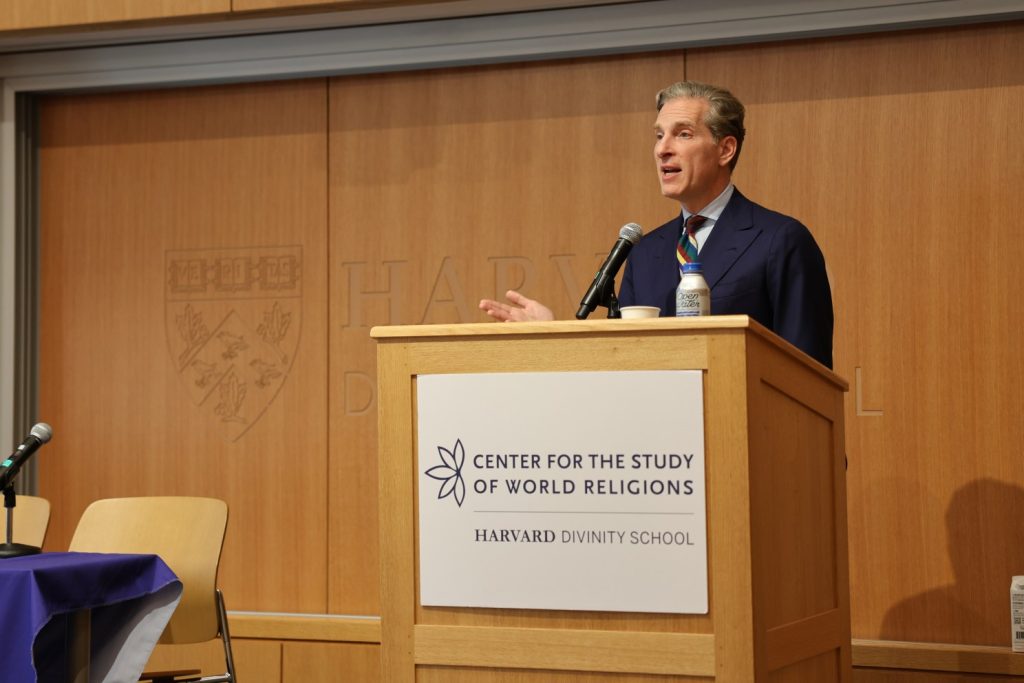

Noah Feldman.
Photo by Paula Ortiz
Health
Psychedelics and the search for truth
Legal scholar sees common interests with law, religion, humanities
Universities and psychedelic experiences have something in common, argues Noah Feldman: they can act as an aid in the pursuit of the truth.
In a keynote speech at the Psychedelic Intersections Conference at the Harvard Divinity School last week, Feldman, Arthur Kingsley Porter University Professor at Harvard Law School, proposed that scholars in three academic disciplines — law, religion, and the humanities — could benefit from engaging with the study of psychedelics, although he left aside the question of whether to partake in them.
He began his talk by laying out the resistance facing such an academic alliance — “because the diagnosis is necessary in order to prescribe the cure,” he said.
In the U.S., most psychedelics are classified by the DEA as Schedule I substances. Despite early evidence suggesting therapeutic benefits for anxiety, depression, and other mental health conditions, medical research remains heavily restricted.
Advocates have pursued exemptions to study and consume psychedelics on the grounds of religious liberty, Feldman explained. But, “The law doesn’t want to give out too many get-out-of-jail-free cards, because otherwise it wouldn’t be the law anymore.”
Other advocates have argued that bans on psychedelic use impinge on cognitive liberty: the freedom to alter one’s brain chemistry. Understandably, Feldman said, legal scholars worry about the consequences of that line of reasoning. The humanistic and spiritual study of psychedelics also remains taboo, he said.
To get around those barriers, Feldman posed a twofold diagnostic question: “No. 1: ‘What is a university good for?’ And No. 2, ‘What are psychedelics good for?’ And I’ll refine that to ‘What is psychedelic experiencegood for?’”
To answer his first question, Feldman turned to Harvard’s motto, Veritas. “The University is good for the pursuit of truth,” he said.
And to answer his second: “I think it’s plausible to say that psychedelic experience is also good for the pursuit of truth — not a single truth, but many different avenues and roots that seek experience that is in some sense interested in the truth.”
Feldman, who is the founding director of the Julis-Rabinowitz Program on Jewish and Israeli Law at HLS, pointed to medieval Islamic philosophers who believed that prophecy was the exercise of the imaginative faculty, and imaginative faculty is what allows you to imagine something truer than what is merely visible.
“We might think of psychedelic experience as an exercise of the human imaginative faculty,” Feldman said. “And perhaps equally important, it’s something that could be translated into the languages of law, religion, and the humanities,” to overcome those disciplines’ resistance.
“We might think of psychedelic experience as an exercise of the human imaginative faculty.”
Feldman pointed to a paper from Columbia Law School scholars Jeremy Kessler and David Pozen that framed psychedelic experience not as an issue of religious or cognitive liberty but of epistemic discovery: the right to acquire knowledge.
The law, he said, “does have some independent commitment to the idea of getting at the truth,” as do religion and the humanities.
“A humanistic account of psychedelic experience will take as its raw material not only the phenomenology, from phenomenological reports that people make, but also, and maybe even more importantly, the products of culture themselves that engage with the philosophical and literary and historical questions of the nature of consciousness and its relationship to reality.”
The questions raised by psychedelics, Feldman continued, are all the more relevant in the age of artificial intelligence.
“In the history of our imaginings about intelligences that are nonhuman, every time we imagined a nonhuman intelligence that could speak, we assumed it would be conscious,” Feldman said, citing C-3PO of “Star Wars” and HAL 9000 of “2001: A Space Odyssey.”
“The philosophical inquiry and the humanistic inquiry more broadly into the nature of consciousness — namely, what is it like to be us? And why does that matter? — is the single most pressing philosophical question we have. And what do you know? It’s the same question that we have to ask in relationship to the experiences of consciousness that we associate with psychedelic experience. So far from being peripheral to the humanities, the questions of consciousness, the meaning of experience, the possibility of experience, and the nature of the real in relationship to sense data are at the beating heart of the humanistic endeavor.”
Feldman closed by saying he felt optimistic about the future of the law, religion, and the humanities engaging with the study of psychedelics under their shared interest in the pursuit of truth.
“The pursuit of truth is a tool for making life better, if we believe that truth is good for us,” he said, “and I do.”
The annual Psychedelics Intersections Conference is a collaboration among the Center for the Study of World Religions at Harvard Divinity School; the Mahindra Humanities Center at the Faculty of Arts and Sciences; and the Petrie-Flom Center for Health Law Policy, Biotechnology, and Bioethics at Harvard Law School.
